Skip to content


You sleep eight hours and still wake up foggy. Coffee stops working by mid-afternoon. The tiredness isn't dramatic — it's just always there, a low battery you can never quite recharge. If that sounds familiar, the problem may not be your willpower or your schedule. It may be happening somewhere much smaller: inside your cells.
Where Your Energy Actually Comes From
Every cell in your body contains tiny structures called mitochondria. Think of them as microscopic power plants. Their job is to take the food you eat and the oxygen you breathe and convert it into a molecule called ATP — adenosine triphosphate — which is the fuel your cells spend to do absolutely everything: think, move, repair, digest, focus.
When your mitochondria are running efficiently, energy feels abundant. When they're sluggish — from age, stress, poor sleep, or illness — your cells produce less ATP, and you feel it as fatigue. The exhaustion you experience as a whole person often begins as an energy shortage at the cellular level.
How Light Reaches Your Cells
This is where red and near-infrared light enter the picture. Specific wavelengths of light — particularly around 660 nanometers (visible red) and 850 nanometers (invisible near-infrared) — can penetrate the skin and be absorbed deep within your cells. Near-infrared, being a longer wavelength, reaches further into muscle and tissue than red light alone.
Once that light arrives, it's absorbed by an enzyme inside the mitochondria called cytochrome c oxidase. In plain terms, this enzyme is a key step on the assembly line that produces ATP. A detailed mechanistic review has mapped how red and near-infrared light can stimulate mitochondrial activity and increase ATP production, in part by helping clear a molecule (nitric oxide) that tends to slow the energy assembly line down. The practical idea is simple: rather than handing your body a stimulant, you're giving your cells a nudge to make more of their own fuel.
Orion light panels are engineered with clinical-grade wavelengths (660nm red + 850nm near-infrared) at therapeutic irradiance levels proven in peer-reviewed research. Purpose-built for results — not aesthetics.
Shop Orion Light Panels →Why Muscles Feel It First
Cells that work hardest tend to carry the most mitochondria — which is exactly why muscle tissue is so responsive to light. This is also why so much of the research on energy and endurance focuses on movement. A review of human muscle studies found that light therapy applied to muscle can improve performance and delay the onset of fatigue when used before activity. For anyone who feels physically drained by mid-day, that's a meaningful clue: support the energy machinery, and the tank empties more slowly.
It's worth being honest about expectations. Light therapy isn't a replacement for sleep, nutrition, hydration, or addressing underlying medical causes of fatigue. What it offers is a way to support the cellular foundation that all of those things ultimately rely on. If you want the bigger picture of how this technology works across the body, our complete guide to red light therapy walks through it in depth.
Signs Your Mitochondria May Need Support
Mitochondrial underperformance is rarely dramatic — it doesn't announce itself with a single symptom. Instead, it tends to look like a constellation of low-grade experiences that most people write off as "just how life is." Recognizing the pattern is the first step toward addressing it at the source.
Persistent brain fog. When neurons don't have adequate ATP, cognitive processing slows. This shows up as difficulty concentrating, words coming more slowly than usual, a general feeling of mental haziness that coffee temporarily patches but doesn't fix. Because brain cells have some of the highest mitochondrial density in the body, cognitive sharpness is often an early casualty of poor cellular energy production.
The afternoon energy crash. A sharp drop in alertness in the early-to-mid afternoon — distinct from ordinary tiredness — often signals that cellular energy reserves have been depleted faster than they're being replenished. While blood sugar regulation plays a role, the cellular energy dimension is frequently overlooked. People who support their mitochondrial function consistently often report that the crash flattens out over several weeks, replaced by steadier energy through the afternoon.
Slow physical recovery. If your muscles take longer to recover between training sessions than they used to, or if ordinary daily activity (climbing stairs, carrying groceries) leaves you more depleted than it should, the repair process — which is energetically demanding — may not be getting the cellular fuel it needs. Soreness that lingers three or four days after moderate exercise is a useful signal.
Poor sleep quality despite adequate duration. Sleep is when the body does its most intensive cellular repair work, and that repair requires substantial ATP. People with compromised mitochondrial function sometimes sleep for long periods yet wake unrefreshed — their bodies are attempting repair but not completing it efficiently. Supporting cellular energy production can, for some people, meaningfully improve sleep quality over time.
None of these signs alone confirms a mitochondrial problem, and persistent fatigue always warrants a conversation with a doctor to rule out underlying medical causes. But if several of these patterns sound familiar and conventional explanations don't fully account for them, supporting your cellular energy baseline is a reasonable place to focus.
Stacking Red Light with Other Energy-Supporting Habits
Red light therapy doesn't operate in isolation — it's most effective when it's part of a broader approach to supporting the biology of energy. Several evidence-backed habits work through complementary mechanisms and compound well with consistent light therapy use.
Sleep. Sleep is not passive rest — it's the most biologically productive period in your day, during which mitochondrial repair, metabolic waste clearance (via the glymphatic system), and cellular regeneration peak. No intervention supports energy as reliably as consistent, high-quality sleep. Red light therapy in the evening, used an hour or two before bed, may support this by avoiding the melatonin-suppressing effects of blue and white light — keeping your evening environment conducive to natural sleep onset.
Nutrition. Mitochondria require specific micronutrients to run the electron transport chain efficiently — B vitamins (particularly B1, B2, B3, and B5), magnesium, coenzyme Q10, and adequate protein all play roles. A diet that chronically undersupplies these nutrients will limit what any other mitochondrial support tool — including red light — can achieve. Think of nutrition as supplying the raw materials; light therapy helps the machinery run better on those materials.
Cold exposure. Brief cold exposure — cold showers, cold-water immersion, or cryotherapy — has been shown to upregulate mitochondrial biogenesis: the process by which cells generate more mitochondria. More mitochondria means greater total energy production capacity. Some people find that pairing cold exposure in the morning with red light therapy later in the day provides a noticeable energy stack across the day, though the research on combining these modalities is still early.
Exercise. Physical training is the most powerful known stimulus for mitochondrial adaptation. Regular aerobic exercise increases both the number and efficiency of mitochondria in muscle cells, which is why trained athletes generally have higher baseline energy capacity than sedentary individuals. Red light therapy and exercise are mutually reinforcing — light supports recovery from training, and training improves the mitochondrial substrate that light stimulates.
How to Use It for Energy
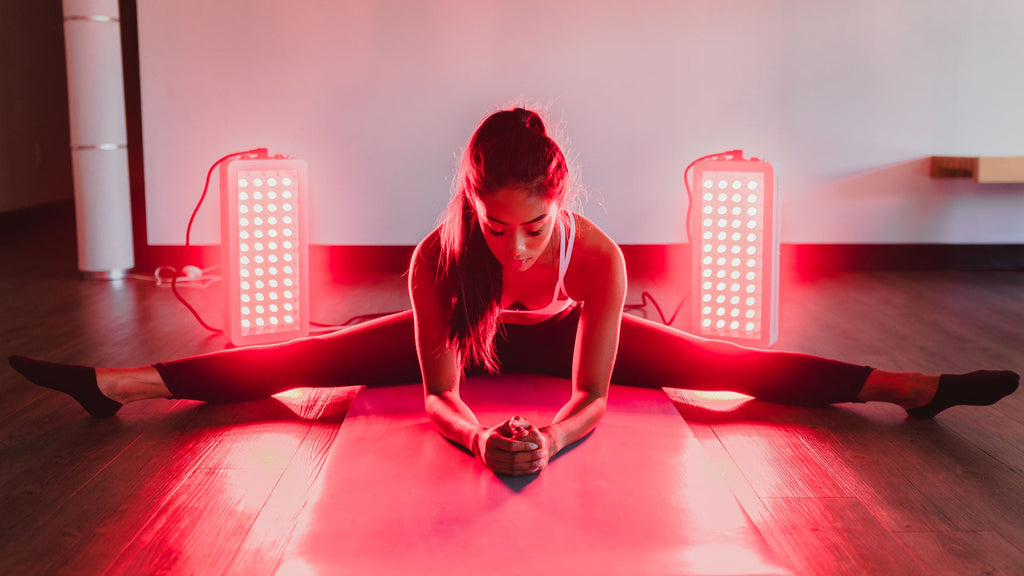
Consistency matters more than intensity. Most people find a rhythm with daily or near-daily sessions of roughly 10 to 15 minutes, positioned so the light reaches a meaningful area of the body — the torso, back, or large muscle groups of the legs. Morning sessions can pair naturally with your wake-up routine; pre-workout sessions can prime muscles before you train.
Keep your skin bare where the light lands, sit or stand a comfortable distance from the panel as recommended for your device, and let the session be a quiet pause in your day rather than another task to rush through. We recommend wearing protective eyewear during close facial sessions — not because red or near-infrared light has been shown to harm healthy eyes, but as a standard precaution against prolonged direct exposure to high-intensity LEDs at close range, and to keep sessions comfortable.
Frequently Asked Questions
How soon might I notice a difference in energy? Cellular changes are gradual. Many people describe feeling steadier energy and less of an afternoon crash after a few weeks of consistent use, rather than an instant lift.
Is this the same as the warmth from a heat lamp? No. Heat lamps warm the skin's surface. Red and near-infrared light work through wavelength absorbed by your cells — the gentle warmth you may feel is a side effect, not the mechanism.
Can I use it alongside caffeine or exercise? Yes. Light therapy supports your body's own energy production and isn't a stimulant, so it fits comfortably into an existing routine.
Does red light therapy help with chronic fatigue conditions? This is an area of active investigation. Some early research suggests photobiomodulation may support people with fatigue-associated conditions, likely through its effects on mitochondrial function and inflammation. However, chronic fatigue syndrome and related conditions are complex and require medical management — red light therapy may be a supportive complement to that care, not a standalone solution. Always work with your healthcare provider on any chronic condition.
Is there a best time of day to use red light therapy for energy? Morning or pre-workout timing tends to work best for the energy and performance benefits, as stimulating mitochondrial activity ahead of the demands of the day gives cells the fuel advantage when you need it most. Evening sessions are also well-tolerated and support recovery — just avoid positioning the panel directly in your eyes in the hour before bed if you're sensitive to light at that time.
Refueling From the Inside Out
Real energy isn't something you borrow from a cup and pay back later — it's something your body builds, one cell at a time. By supporting the mitochondria that power you, red and near-infrared light offers a quieter, more fundamental kind of recharge. Not a jolt. A restoration. And for a body that's been running on empty, that may be exactly the difference worth feeling.